You Spoke Mind the Gap
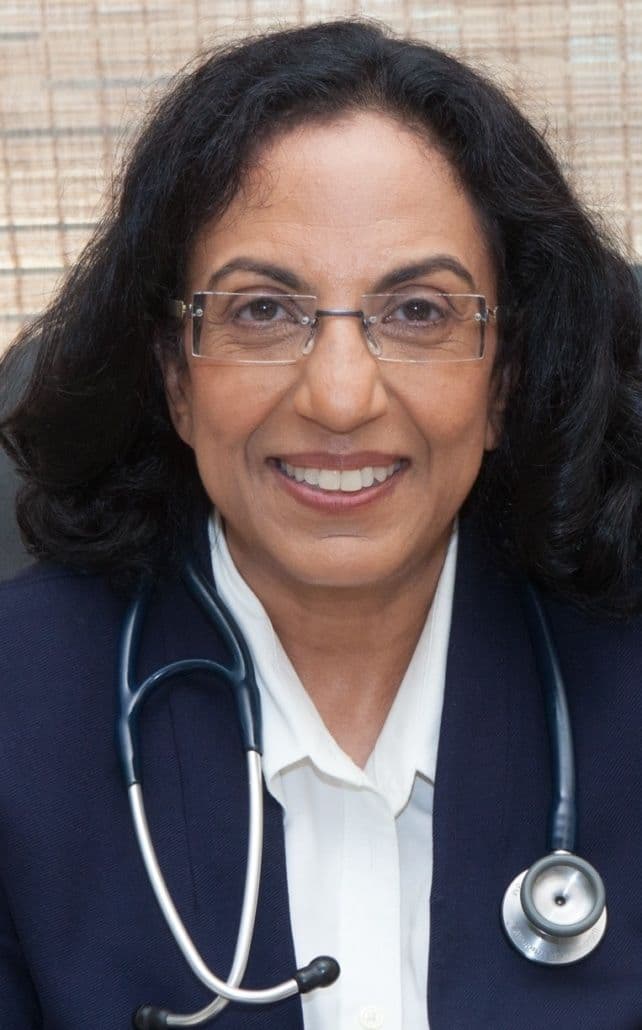

Many of you wrote. Some called. Others texted. From California to London to India, you spoke. Your responses were varied: They came from pharmaceutical company executives, physicians across disciplines, authors, coaches, and patients. Consummate problem solvers, high achievers, everyone. And not one of them is immune to the gap we see everywhere.
I know I am not the only person who has lived the gap in medicine. It reaches into health, finances, relationships, and mental wellbeing. Here is what you told me, edited lightly for accuracy and easier reading.
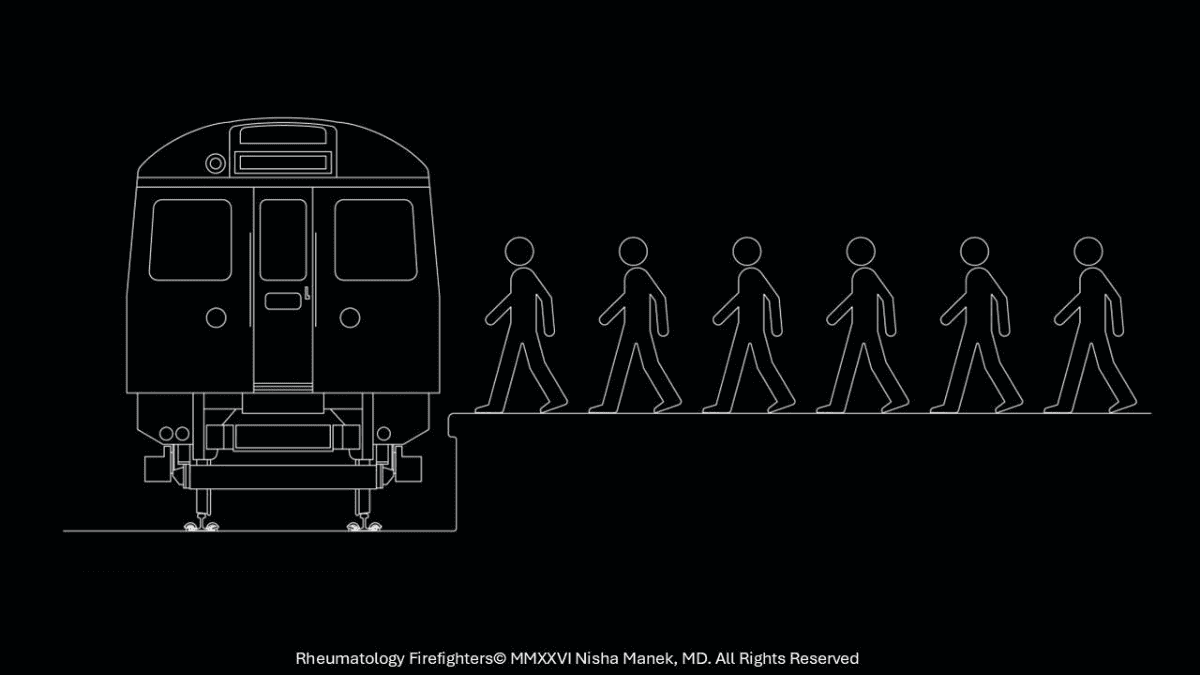
THE GAP, NAMED
“They didn’t ask me the right questions to begin with.”
— DK, San Francisco, Bay Area, California
After twenty-five years of hypothyroidism and untreated anemia, Durga’s hemoglobin fell to 6.0 before iron treatment finally brought rapid relief. The underlying cause emerged only after extensive testing, though no one had initially asked the deeper questions that might have revealed it sooner. Her labs are normal now, but she knows stability is more than two results: grief, work stress, menopause, and daily life all register in her body. She wants a medical system to make room for that lived data, not just the numbers on the chart.
“How much heart-to-heart can be shared in fifteen minutes?”
Andrea, Hawaii
“From taking our vitals to the doctor checking on us is fifteen minutes. Then I’m out of there. How much heart-to-heart can be shared in fifteen minutes? I brought my supplements to show her, told her my knees felt better. She wasn’t even curious to look. They are not trained to listen with their hearts.”
“They kept telling me, ‘Your thyroid labs are fine.’”
Paulina, California
For years she was told she was fine. She did not feel fine. Sleep that never restored her, exhaustion, the sense of being waved off. She tracked her body temperature on her own. “It was around 96 degrees.” A low body temperature was a sure sign the thyroid was not right. But all the doctor’s attention stayed on the paper results. Paulina is finally being treated for how she actually feels, and slowly, she is turning the corner. “My temperature is slowly improving. For the first time in a long time, I now sleep through the night.”
“It was always the same. Take this, or else.”
Michael, California
“I fired six cardiologists.” Every visit came with the same message: take this, or else. Michael said, “I asked why my heart pumps in the low range. The answer from every cardiologist was, ‘I don’t know.’ And I’d get another script, none of which helped improve my heart function. I felt the loss of my freedom, tied to people who had already decided that another pill is the answer.” Michael kept searching until he found a doctor who would listen. Not defiance for its own sake. He simply refused to be managed by fear, and finally found a partnership instead. “I walk every day, even though the heart ECHO predicts I cannot do any exercise.” His activity level mystified his previous doctors. No one seemed curious about what he could do. “I am better because I took charge of my own health.”
“I think this is the medication.”
Karen, you spoke of being ignored
Karen, in her mid-sixties, started a bone drug for osteoporosis and landed with chest pain she had never felt before. She knew the side effects, but because the pain was new, she went in to be sure it wasn’t her heart, first to urgent care, then the ER. After telling the urgent care doctor and again in the ER, “I think this is from the medication,” no one wanted to be the one to say so, and the workup chased her heart instead. It came back normal. She stopped the drug herself. The chart looked for a heart attack. Nobody looked at what she was actually telling them.
“True healing includes body, mind, and spirit.”
Antonette Opperman, South Africa
“I feel the gap where treatment focuses mainly on medication, while true healing also includes the physical, mental, emotional, and spiritual parts of who I am. For me, the gap is not only ‘Is my disease under control?’ but also: Am I sleeping well? Do I have peace of mind? Do I have energy for my family, and to serve others? Do I feel spiritually connected and hopeful?”
“It’s not too little information. It’s too much.”
Suraj, Kerala, India
“It’s not the lack of information; it’s too much information and chaos outside. How to tune in, how to find the right guide, how to find the path ahead, that is the real gap.”
THE GAP, FROM THE OTHER SIDE
“You’ve explained my skin like no one ever has.”
A dermatologist, New York
“Endocrinologists put patients on GLP-1 drugs, and the side effects- hair loss, facial volume loss, sagging skin- get sent to me in dermatology to clean up. What these patients actually want is to be taught how to care for themselves. What I hear again and again is, ‘You’ve explained my skin issues like no one ever has.’”
“You can see the gap clearly and still not be given what it takes to close it.”
A physician in California
“I did everything to close the gap. I trained beyond my specialty, learned the nutrition, the microbiome, the whole-person work. Patients found me, hundreds waiting. And I still hit the gap, because the system won’t staff it or make room for it. You can see the gap clearly and still not be given what it takes to close it.”
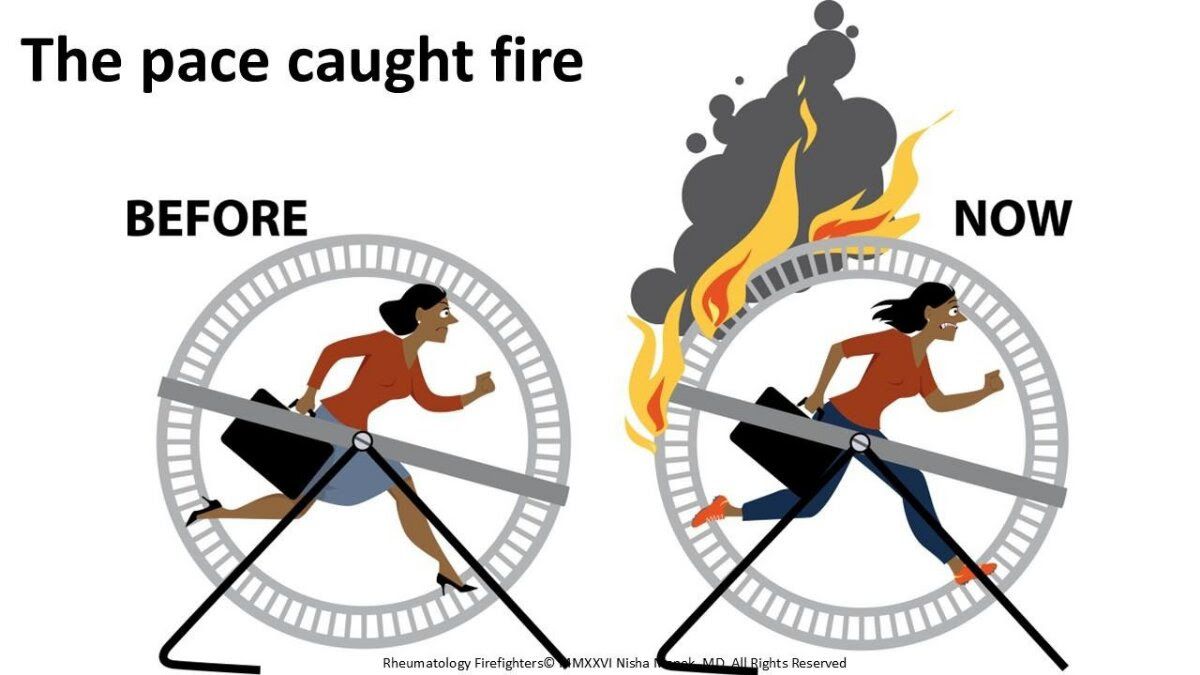
“I’ll be away from home again.”
A respiratory therapist, Northern California
The need for her expertise is that great, so she is recruited far from home. Always on call, every message due within the hour, tending patients who cannot go minutes without the oxygen she manages. She watches good people burn out and leave, because the workload was built for a system, not for a human being. What keeps her standing, she says, is her faith. She shows up, she does the work, and she prays for the ones she cannot fix.
“It’s about patents and competitors.”
You spoke from inside the industry
She works in drug development in Europe, and she reads these newsletters from the other side of the gap. From the inside, she says, the meetings are about patents, competitors, and shareholder targets. When she steps back, she doesn’t see the patient in the discussion. So before every meeting, she prays: “Let me hold on to the patient in all of this.” In this way, “I do my small part to keep the people we serve in view.”
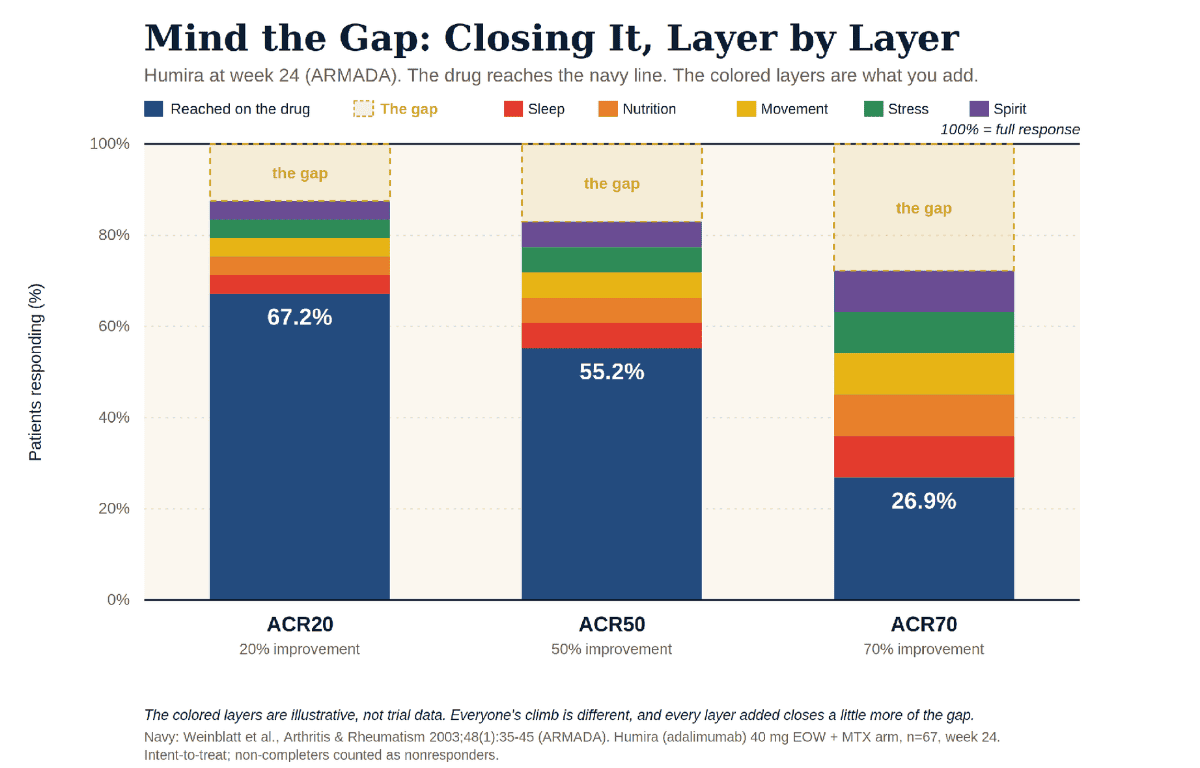
THE GAP, CLOSING
“It’s a full-time job, this lovely RA.”
Paula, Miami, Florida
“I’ve lived with RA for seven years.” Ask how she manages it, and alongside her medical care, she doesn’t name a single therapy. She names a life. Pickleball three times a week. Ten thousand steps a day. Modified yoga, hiking, dancing, church on Sundays, daily meditation, 3-6-9 intention writing, and the vagal breathing she first learned in my five-week course back in 2023 and never put down. “It’s a full-time job,” she says, “this lovely RA.” No single piece closes her gap. It’s the whole stack, sustained, day after day, that does.
“My daily intention writing is the one thing that orients my life.”
Kimberly, you spoke of what medicine could not reach
“I have lived with RA for many years. I can name the medicines: methotrexate, steroids, Plaquenil, joint injections, countless doctor visits. What lifts me is the subtle energy of being around my Gypsy Vanner horses. I have taken the Rheumatoid Relief course twice. And my daily intention writing is the one thing that orients my life. I have a canvas tent with my thoughts written on the walls. It is my sanctuary.”
AND BEYOND MEDICINE
“The gap is everywhere.”
Daniel, baseball coach, from the ballfield
“So many of your articles circle it: the gap in food labels, medicine, consciousness. The gap is everywhere.”
THE GAP SHOWS UP ON LABELS, TOO
While I was writing this, the Texas Attorney General opened an investigation into food makers over “heart healthy” labels. I hold no brief on politics or the specific science. But the shape of it is familiar. “Heart healthy” can be read as a checkmark that says ‘target met.’ A reassuring label doesn’t always close the gap. Sometimes it widens it, by telling you you’re on the right track. Same lesson as your medical chart: mind the distance between the mark and the truth.