Sauerkraut in Washington


Dear Friend,
Sometimes the clues in medicine show up in unexpected places, and we have to stay alert to them. In Issue 8, I promised you sauerkraut in the White House. Turns out it is not the President eating it. It is his whole Cabinet. And the clue did not come from a medical journal. It came from the Lifestyle and Fitness section of a national newspaper.
The Wall Street Journal ran a story on June 18. The headline alone made me stop drinking my coffee and start reading the article: cabinet officials in Washington, eating sauerkraut!
A Very Public Case Report
Health Secretary Robert F. Kennedy Jr., Commerce Secretary Howard Lutnick, Transportation Secretary Sean Duffy, and Vice President JD Vance are, by the Journal's account, all on the same plan. Grass-fed meat. No alcohol. No sugar. And heaping portions of fermented food, sauerkraut and kimchi chief among them.
The physician behind this sauerkraut craze is Dr. Sean O'Mara. He runs a private practice built around full-body imaging and metabolic optimization. His pitch is not exotic. Eat fermented food. Eat grass-fed protein. Put down the sugar and the alcohol. His patients report a leaner build, a calmer gut, and skin that looks, in his words, better than it has in years.
“Within 30 days I lost 20 pounds,” Kennedy said. “JD Vance is also on the diet.”
Kennedy is 72. He also credits the diet with quieting the aches and pains he had been carrying, and with the disappearance of the atrial fibrillation he had been experiencing. I want to be precise here, because precision is the whole discipline of medicine. This is self-reported. Mr. Kennedy has not, to public knowledge, produced a cardiology report to confirm the arrhythmia resolved for the reason he thinks it did. Correlation made the headline. Causation is a harder case to close, and I am not going to pretend otherwise.
But I am also not going to dismiss it. A 72-year-old man reporting less pain, a lighter frame, and a quieter heart rhythm after a year of real dietary change is an important pointer. And when the Health Secretary changes his own diet, people notice.
The $18,000 Medical Prescription
Here is the part in the article that made me stop drinking my coffee altogether and pay attention. Dr. Sean O'Mara’s “optimization plans” start at $8,000. A single direct consultation runs $18,000. For that fee, he will personally walk you through a grocery store and show you where to find live-culture ferments in the back of the refrigerated case, away from the light that degrades the microbes.
I have been telling my patients about this for years, at no charge during my follow-up visits. The advice was never the expensive part. Access to someone who will say it to you plainly, and mean it, apparently is.
Culture Shock: From the Jar to the Situation Room
Set the politics aside. Set the price tag aside too. What is actually happening inside a body that adds fermented food back into its diet? You need to get on board with the culture. Pun intended.
In 2021, researchers at Stanford ran a controlled ten-week trial comparing two diets: one high in fiber, one high in fermented foods. Both groups were healthy adults, without chronic disease. The fiber group's microbiome barely moved. The fermented-food group's microbiome diversity rose, and it kept rising the longer the study ran. Better still, markers of inflammation that doctors watch closely, like interleukin-6, fell. This means less inflammation, less fire.
in the fermented-food arm over ten weeks, including interleukin-6, the same signal tracked in rheumatoid disease. The high-fiber arm showed no comparable drop. Wastyk et al., Cell, 2021.
This is the Inner Ecosystem dispatch again, from Issue 5, walking back through the door in a different coat. The microbes produce butyrate which turns down the body’s master inflammatory switch NF-κB. A more diverse gut community produces more of it. Fermented food is one of the fastest, cheapest ways to diversify that community. The Cabinet did not discover anything new. They rediscovered something old enough to predate refrigeration.
The Firefighter's Read
A firefighter does not care whether the spark started in a palace or a farmhouse. A fire is a fire, and fuel is fuel. What Washington's kitchens are doing, whether they know the mechanism or not, is starving a fire of one of its favorite fuels: a thin, poorly diverse gut community that lets inflammatory signals run loose.
You do not need a full-body MRI or an $18,000 consultation to start. You need a jar, some cabbage, and patience. Or, if fermentation is not calling to you yet, you can start somewhere gentler and just as real: whole, unprocessed food, prepared simply, eaten the way it grew.
A Recipe Worth Keeping and Passing On
The Cabinet would like this one too. No sauerkraut required, just vegetables, good olive oil, ocean salt, and a little lemon. All the ingredients this series has already asked you to trust.
This one comes from Chef Eyal Shani, out of his Miznon restaurants in Israel, open source and beloved for a reason. He calls it a bag of green beans. I call it better than french fries, and I mean that as a rheumatologist, not just as a cook.
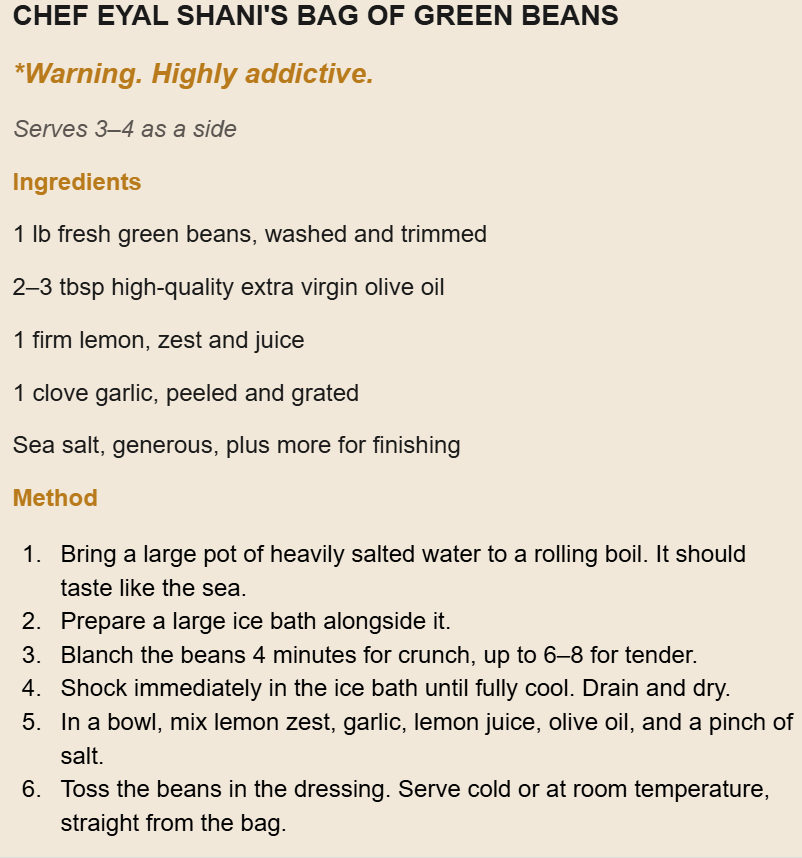

No seed oil. No fryer. No ingredient you cannot pronounce. Just heat, salt, cold, and a little acid, doing what good cooking has always done, which is get out of the food's way.
A MOMENT OF REFLECTION
What Is on Your Plate Telling You?
A cabinet secretary needed a diagnosis, a diet, and a year to feel less pain. What would it take for you?
You do not need $18,000 to start. What is the one small, live, fermented thing you could add this week?
Until next time, remember: the smallest living things do the largest work. A spoonful of live culture, hidden in a body, quietly changes the whole.