Hidden in Plain Sight

Sharon was eating salads. She was gaining weight. The answer was in front of her all along.
Dear Friend,
Previously, I left you with a question. Sharon, 57, has seropositive RA and knee pain. She ate salads and vegetables daily, yet the weight wouldn’t come off, and inflammation persisted. I then asked her to do something no patient had ever been asked to do. Look at Sharon’s before-and-after pictures. These dramatic results are real. If you also struggle with weight, fitness, or health, this is for you.
A big thank-you to the many readers who wrote in with their guesses. Some came close. Most thought about the salad itself. What was in it? What was she eating? The answer was not the salad.
Everything Medicine Had to Offer
Before I tell you what worked, I want to tell you what didn’t. The full weight of Sharon’s story only lands if you understand what we did. What we tried and for how long. And how close we both came to giving up. She arrived at my clinic after years of trying everything.
The Diets
She had tried them all. Low-calorie. Low-fat. Gluten-free, dairy-free, and no fake creamers. The nutritionist’s plan. The ones her friends swore by. Each one began with hope. Each one ended the same way: the weight came off slowly, then stopped, then crept back. The hunger was relentless. The discipline was real. The results were not.
Physical Therapy
Referred. Attended. Completed the program. Referred again. Attended again. The PTs were skilled, Sharon was compliant. Strengthening exercises for quadriceps. Range-of-motion. Her knees hurt less for a week. Then the same. Then worse.
Pool Therapy
Pool therapy. The unloading of body weight in water, the gentle resistance, the warmth. Sharon went. Twice a week. For the Summer months. She found it soothing. She found it temporarily relieving. She did not find it transformative. The knees came out of the pool the same way they went in.
Knee Injections
Corticosteroid injections into the knee joint. Modest pain relief. Then the inflammation returned, a little more stubborn each time. The joint space on imaging was narrowing. I was injecting a joint whose environment was being bathed in inflammatory fuel every day.
Orthopedics
The surgeons reviewed her imaging. The recommendation was clear: lose weight before attempting any knee replacement. Devastating for Sharon, who had been trying to lose weight for years without success.
I want you to sit with that for a moment. Because this is not an unusual story. I see versions of Sharon every week. Patients who are compliant, who are trying, who are following every instruction they have been given, and for whom the system has run out of ideas. The next step is another drug. A stronger drug. A more expensive drug. And when the drugs are not enough, the system looks at the patient and says: The problem is you. Lose weight. Then we can help.
The Alarm Is Still Ringing
This matters beyond one patient. The obesity epidemic is not slowing down. One in two American adults is projected to be obese by 2030. The ground is shifting underneath medicine and underneath rheumatology in particular, because obesity is not just a weight problem. Obesity is inflammation. It is, in many of our patients, the fire beneath the fire.
The medical system’s answer to this has been, broadly: more drugs. Better drugs. Newer biologics. GLP-1 receptor agonists. These tools have real value, and I do not dismiss them. But they are answers to a question we are only half-asking. The full question is: what is causing the fire? And the answer, in many cases that I have seen, turns out to be hidden in plain sight.
I went into my firefighting mindset. What is the state of Sharon’s inner terrain? With all the effort she was putting in, what was fueling the fire? It was a seat-of-the-pants question. No EHR template suggested it. No billing code existed for it. It came from a place of the best clinical questions: a genuine curiosity about the life of the person in front of me.
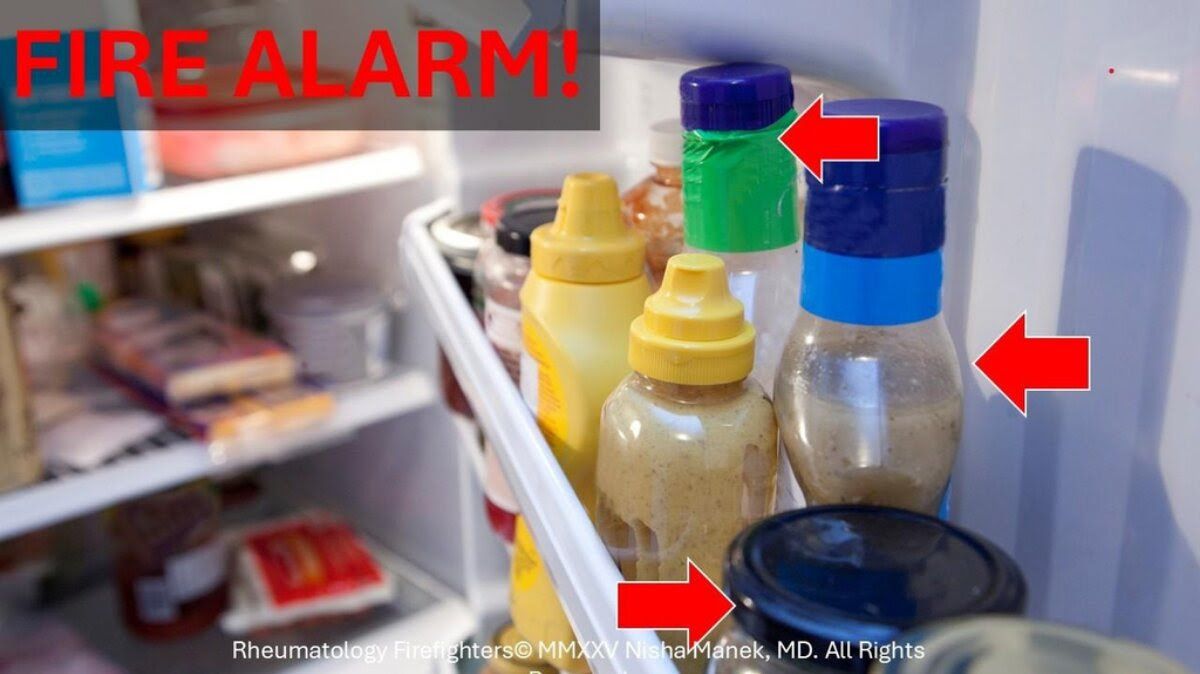
She did it. She took the picture.
And when she showed me the photograph of the inside of her refrigerator, she pointed it out herself. She looked at the image and said, almost sheepishly:
“You know, I love dressings.”
The door of her refrigerator. Lined with bottles. Ranch. Caesar. Italian. Mayo. Every salad she had eaten for months, every disciplined, carefully assembled plate of vegetables had been drowned in them. She had not thought of the dressings as a problem. Why would she? They were in the refrigerator, not the counter. They came in bottles labeled “light,” “fat-free,” and “garden fresh.” They were the accompaniment to the virtuous salad, not the source of the problem.
I went to my local supermarket. I stood in the salad dressing aisle and counted the bottles. Dozens. Wall to wall. And the first ingredient on nearly every single one: SOYBEAN OIL. CANOLA OIL. VEGETABLE OIL.
These are seed oils. And their rise in the American diet has been one of the most dramatic and least discussed shifts in the history of nutrition. In 1865, seed oils accounted for roughly 1 gram per person per day. By 1999, consumption had reached 18 grams. By 2008: 29 grams daily. From 1/100th of total calories in 1865 to more than one quarter of total calories by 2010. A 25-fold increase in just over a century.
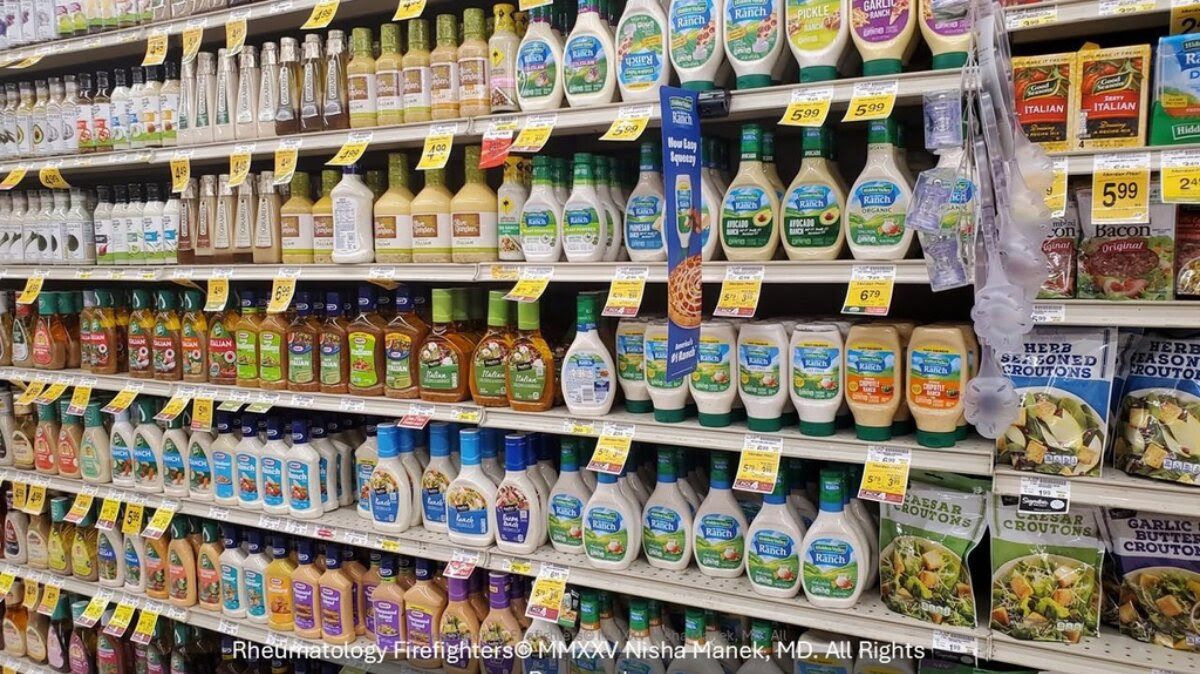
I read label after label after label. There was not a drop of olive oil in any of them. Instead, a seed-derived, industrially processed, hexane-extracted, deodorized oil that fills your cell membranes with reactive oxidizing agents every time you dress a salad.
Sharon was consuming more than 500 inflammatory calories per day from dressings alone. Not from sugar. Not from junk food. From the bottles lined up in the door of her refrigerator, next to her fresh vegetables, waiting patiently to undo everything the vegetables were trying to do.
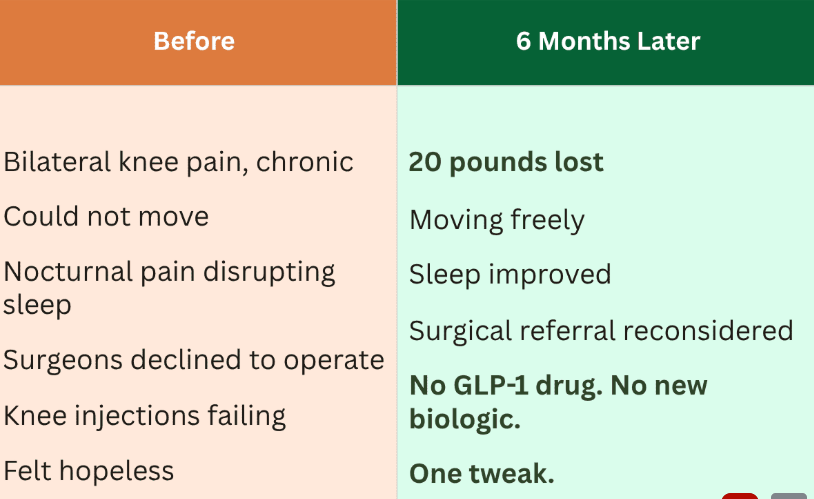
Sharon changed one thing: she threw out the seed oil dressings and replaced them with something her grandmother would have recognized. She lost 20 pounds in 6 months. No GLP-1 drug. No new prescription. No surgery. And yes, she now walks and has a new puppy.
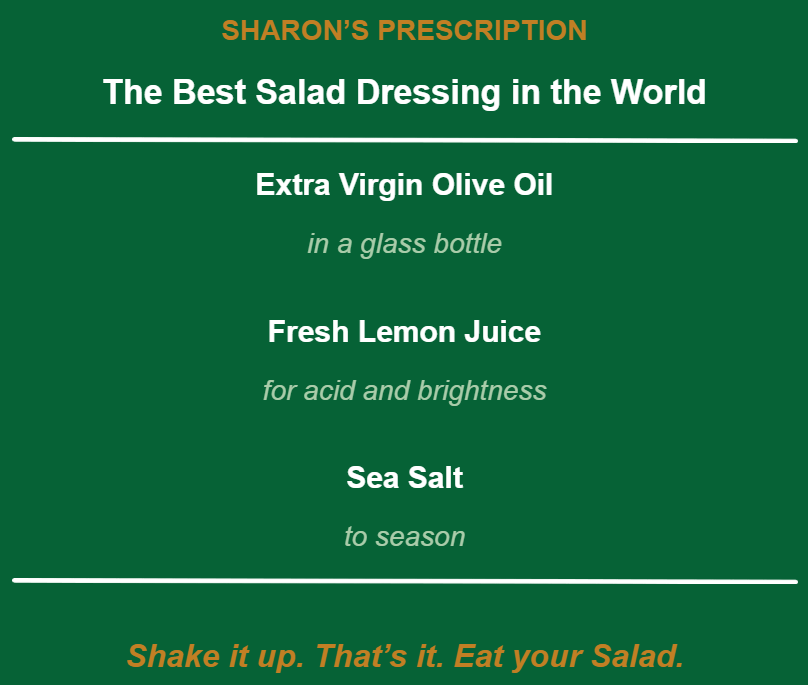
It costs less than any bottled dressing. It takes thirty seconds to make. It has no ingredient list because it doesn't need one. And it is what I now give every patient who tells me they eat salads but cannot understand why they cannot lose weight.
This is what I mean when I say our patients already hold the answers. Sharon found hers. She pointed it out herself. I did not diagnose the dressing she did. I just asked the question that let her see it.
And that question, “Would you be willing to take a picture of the inside of your fridge?” was not in the Review of Systems. It was not in any protocol I had ever been taught. Asking what no one had asked before. And listening to what the patient already knew.
TAKE STOCK
What Is in the Door of Your Fridge?
Open your fridge. When did you last read the label on your salad dressing?
If you eat a salad every day and dress it with a seed oil dressing, you may be adding inflammation to your food.
Sharon pointed it out herself. What is the thing in your own diet that you already suspect, but haven’t yet looked at directly?
What would change if you made your own dressing this week? Just once. Three ingredients. Five minutes.
COMING IN ISSUE 05
If seed oils are hidden in dressings, where else are they hiding? What other deleterious health effects might they have? What else is happening inside your gut? Go deep. The answer will surprise you.
Until next time, check the door of your fridge. The answer to your healing may be hidden in plain sight.